Perimenopause meaning: "Peri-" means "around," so perimenopause literally means "around menopause." It is the natural transition period before menopause when your ovaries gradually produce less estrogen and progesterone, causing a range of physical, emotional, and cognitive symptoms. It typically begins in the early-to-mid 40s, lasts an average of 4-8 years, and ends when menopause is reached (12 consecutive months without a period). This guide covers everything a beginner needs to know.
This article is for informational purposes only and is not medical advice. Always consult a healthcare provider about your symptoms.
What is perimenopause in plain language?
Think of it this way: menopause is a moment (the 12-month anniversary of your last period). Perimenopause is the journey getting there. During this journey, your ovaries are winding down their reproductive function. But they do not wind down smoothly — they fluctuate, sometimes producing more estrogen than during your prime reproductive years, sometimes producing much less. This hormonal instability is what causes symptoms.
Every woman who goes through natural menopause goes through perimenopause first. It affects approximately 1.3 million women entering the transition each year in the United States alone.
When Does It Start and How Long Does It Last?
Typical onset: Early-to-mid 40s, though it can start in the late 30s.
Average duration: 4-8 years.
Range: A few months to over 10 years.
Ends at: Menopause (average age 51 in the US).
Factors that influence timing include genetics (the strongest predictor), smoking (accelerates the process by about 2 years), body mass index, prior ovarian surgery, and autoimmune conditions.
What happens to your hormones during perimenopause?
Understanding the hormonal picture helps everything else make sense:
- Progesterone declines first. As ovulation becomes less consistent, progesterone drops. This affects sleep, mood, and menstrual patterns. Low progesterone relative to estrogen is responsible for many early symptoms like anxiety, insomnia, and heavier periods.
- Estrogen fluctuates wildly. Unlike the gradual decline many expect, estrogen spikes and crashes during perimenopause. These fluctuations cause the most acute symptoms — hot flashes, mood swings, brain fog.
- Eventually, estrogen declines. In late perimenopause, estrogen trends downward, leading to the end of menstruation and symptoms related to sustained low estrogen like vaginal dryness.
- Testosterone gradually decreases. Though less dramatic than estrogen and progesterone changes, declining testosterone can affect libido, muscle mass, and energy.
What are the stages of perimenopause?
The STRAW+10 system divides the reproductive lifespan into stages:
Early Perimenopause
Your cycle length varies by 7+ days from your normal pattern. You are still menstruating but the regularity is changing. Symptoms tend to be subtler: increased anxiety, worse PMS, sleep disturbance, the beginnings of brain fog. Many women do not realize they are in early perimenopause.
Late Perimenopause
You have gone 60+ days between periods (but less than 12 months). Symptoms typically peak in intensity — hot flashes are most frequent, mood changes most pronounced, and cognitive symptoms most noticeable. This stage often lasts 1-3 years.
What are the most common perimenopause symptoms?
Perimenopause can produce over 34 documented symptoms. The most common include:
- Irregular periods — the hallmark symptom, affecting 90%+ of women
- Hot flashes and night sweats — affecting about 75% of women
- Sleep disruption — affecting 40-60% of women
- Mood changes — anxiety, irritability, mood swings, depression
- Brain fog — difficulty concentrating, memory lapses, word-finding problems
- Fatigue — persistent tiredness unrelieved by rest
- Weight gain — particularly around the midsection
- Joint pain — new stiffness or aches
- Headaches — new or worsened, often hormone-related
- Heart palpitations — racing or fluttering heartbeat
- Decreased libido — reduced sexual desire
- Vaginal dryness — thinning and drying of vaginal tissues
No two women experience perimenopause identically. Some have mild symptoms that barely register. Others experience severe disruption that affects work, relationships, and quality of life. Most fall somewhere in between.
How Is Perimenopause Diagnosed?
There is no single definitive test. Hormone levels fluctuate too much for a single blood draw to be diagnostic. Diagnosis is typically based on:
- Your age (40s is the most common time)
- Changes in menstrual pattern
- Characteristic symptoms
- Ruling out other conditions (especially thyroid disorders)
This is why consistent symptom tracking is so valuable. When you can present a healthcare provider with weeks or months of documented symptoms, cycles, and patterns, the picture becomes much clearer than a single appointment conversation.
What Can You Do About It?
Lifestyle Interventions
- Regular exercise: Improves sleep, mood, cognitive function, bone health, and weight management. Aim for 150 minutes per week.
- Nutrition: Focus on anti-inflammatory foods, adequate protein, calcium, vitamin D, and omega-3s. Limit alcohol, caffeine, and refined sugar.
- Sleep hygiene: Consistent schedule, cool room, screen-free wind-down routine.
- Stress management: Meditation, yoga, deep breathing, and setting boundaries all help buffer the hormonal transition.
Medical Options
- Hormone therapy (HT): The most effective treatment for hot flashes, night sweats, and vaginal dryness. Modern HT uses bioidentical hormones at lower doses and is considered safe for most women under 60 or within 10 years of menopause onset.
- Low-dose antidepressants: SSRIs and SNRIs can reduce hot flashes and improve mood, even at sub-antidepressant doses.
- Vaginal estrogen: For vaginal dryness and urinary symptoms. Acts locally with minimal systemic absorption.
- Cognitive behavioral therapy (CBT): Effective for insomnia, anxiety, and improving overall quality of life during the transition.
Track Your Experience
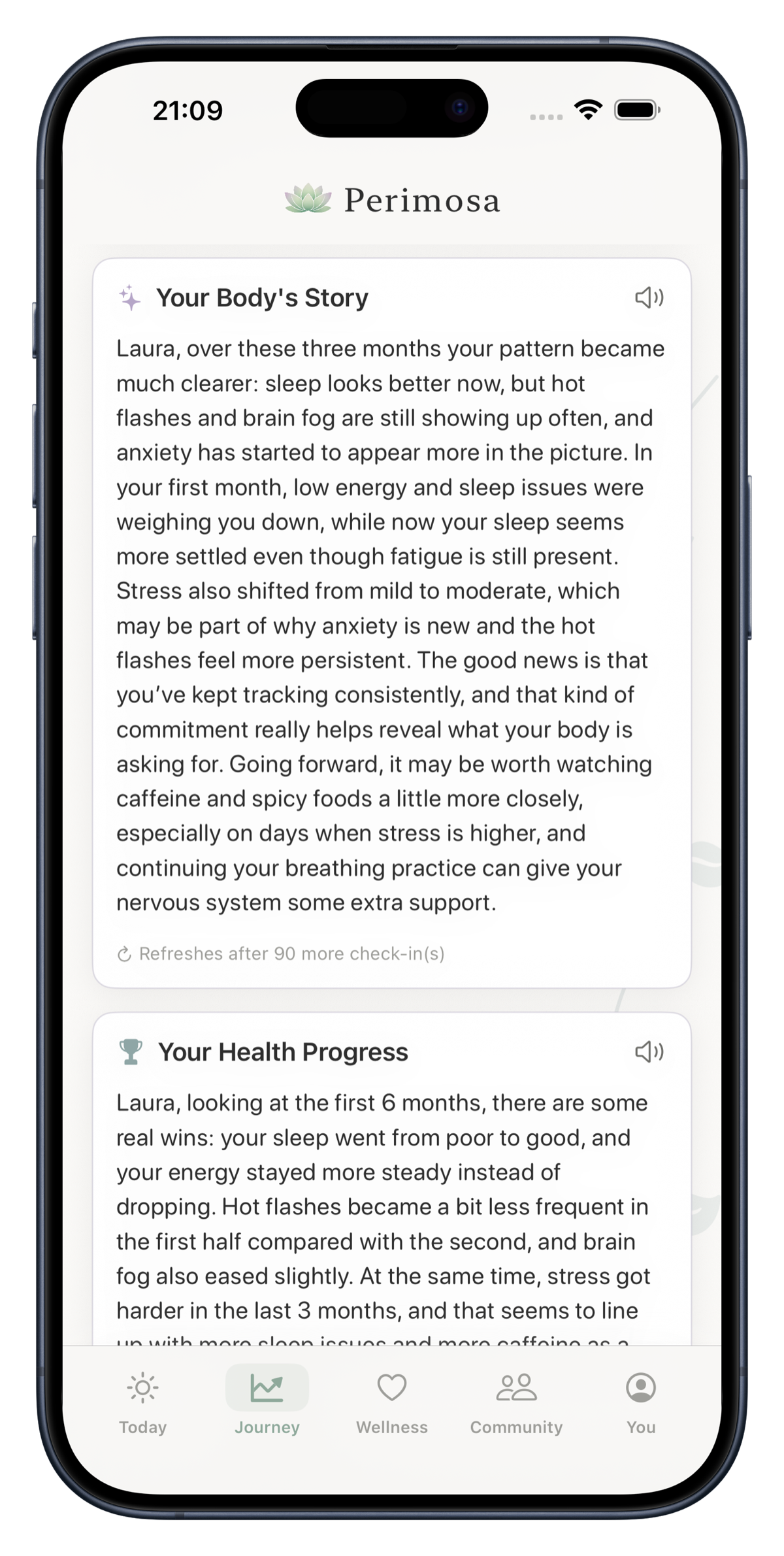
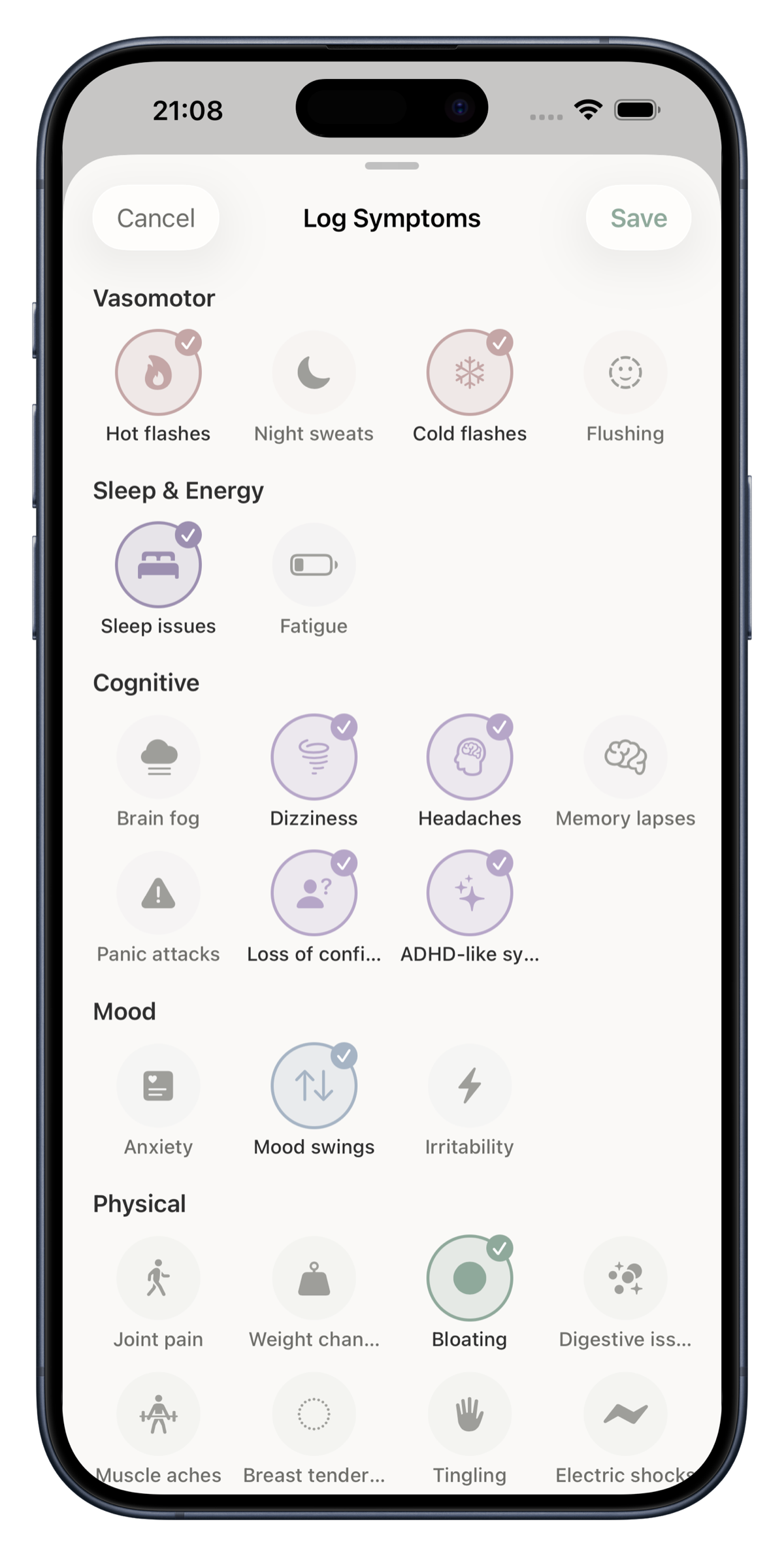
One of the most empowering things you can do is start tracking your symptoms daily. It takes less than a minute and transforms how you understand your body. Perimosa was built specifically for perimenopause — tracking 30+ symptoms, daily mood and energy, and using AI to spot patterns in your data. When you can see the patterns, the transition feels less chaotic and more manageable.
Perimenopause vs. Menopause vs. Postmenopause — The Words Defined
The terminology is one of the most confusing parts of the transition. Each word means something specific:
- Perimenopause: The years-long transition before menopause. Periods still happen but become irregular. Symptoms appear and fluctuate. Hormones are unstable.
- Menopause: A single point in time — the 12-month anniversary of your last menstrual period. You can only identify it looking backward.
- Postmenopause: Everything after that 12-month mark, for the rest of your life. Hormones stabilize at their new lower baseline.
- Premenopause: Sometimes used loosely to mean "before menopause," but technically refers to the entire reproductive lifespan before perimenopause begins.
So when people say "I'm in menopause" while still having symptoms and occasional periods, they almost always mean perimenopause. The popular usage and medical definition differ.
How Do You Know If You're in Perimenopause?
There is no single definitive test, but the combination of these signs strongly suggests you are in the transition:
- Your cycles have changed by 7+ days from your personal norm — shorter, longer, or both
- You are between ages 38 and 52 (the typical window, though it can start earlier or later)
- You have new or worsened sleep disruption, especially in the second half of your cycle
- You have new or stronger PMS — anxiety, irritability, breast tenderness
- You have occasional hot flashes — even one or two per month is significant
- You feel "off" in a way you can't quite name — many women describe this as not feeling like themselves
Three or more of these together, especially in your 40s, is enough to start the conversation with a clinician. Hormone tests are not usually required for diagnosis — pattern recognition over time is more reliable than any single blood draw.
What Perimenopause Is NOT
A few common misconceptions worth correcting upfront:
- It is not a disease. It is a normal biological transition. Treatment is for symptom management, not "curing" perimenopause.
- It is not the same as menopause. Menopause is one day; perimenopause is years.
- It does not mean fertility has ended. Pregnancy is still possible until 12 consecutive months without a period.
- It is not just about hot flashes. Many women have more bother from sleep, mood, and cognitive symptoms than from temperature dysregulation.
- It is not "all in your head." The fluctuations are measurable. The symptoms are biological.
- It does not have a predictable trajectory. Some weeks are bad, others fine. The unevenness is the point.
How Long Will Your Symptoms Last?
This is the most-asked question and the hardest to answer because there is no formula. What the research shows:
- Median total duration of perimenopause: 4-8 years
- Hot flashes specifically: median 7.4 years across the perimenopause-to-postmenopause window (SWAN study)
- 10-15% of women have significant symptoms 10+ years after their final period
- Most women report meaningful symptom decline 2-3 years past final period
- Some women experience minimal symptoms throughout — about 15-20% of women report little disruption
The most intense phase is typically the 1-2 years on either side of the final period — when hormones are at their lowest sustained levels but still partially fluctuating. Then it gets better.
You Are Not Alone
An estimated 47 million women worldwide enter perimenopause each year. Despite this, many women feel isolated in their experience. Education and conversation are improving, but there is still a long way to go. Knowing what perimenopause is, why it happens, and that it is a normal biological transition — not a disease or a disorder — is the foundation for navigating it well.
The Bottom Line
Perimenopause is the hormonal transition before menopause, typically lasting 4-8 years and producing a wide range of symptoms caused by fluctuating estrogen and declining progesterone. It is normal, universal, and temporary. Understanding what is happening in your body gives you the power to manage symptoms, have productive conversations with healthcare providers, and take care of yourself during a transition that is simply part of being a woman.